Maui Architectural Photography Featured on Homes & Land Cover
Quick Answer: Who Photographed This Homes & Land Maui Cover?
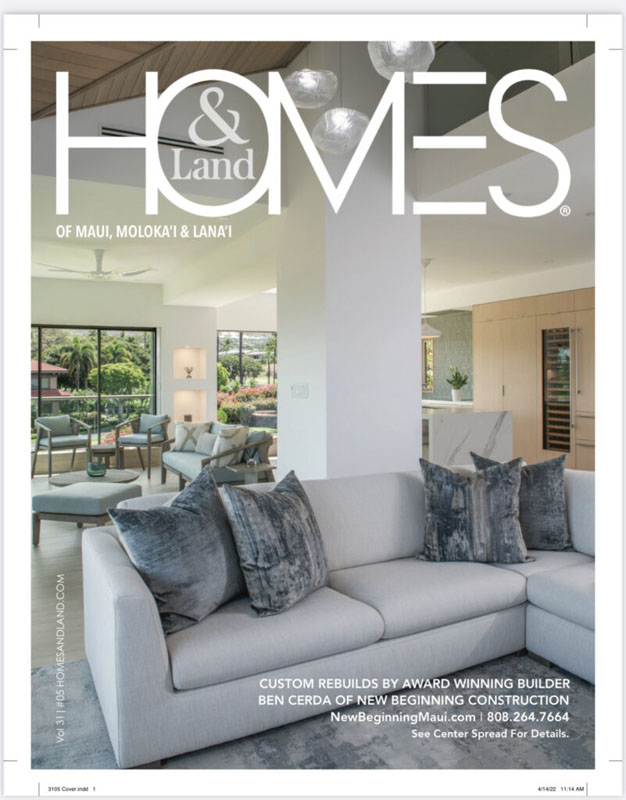
Maui-based photographer Sean Michael Hower photographed the luxury Maui residence featured on this Homes & Land cover. The architectural photography was created to showcase the home’s design, craftsmanship, interior spaces, and relationship with Maui’s environment while producing polished imagery suitable for luxury property marketing and publication.
Having an image selected for a magazine cover is always rewarding, but there’s something particularly satisfying about seeing Maui architectural photography used this way.
A magazine cover has to do more than document a property. One photograph becomes responsible for introducing the entire issue.
For this assignment, Sean Michael Hower photographed a beautifully designed custom Maui residence, creating imagery that highlighted the home’s architecture, interiors, craftsmanship, and indoor-outdoor character.
One of those photographs ultimately found another home of its own: the cover of Homes & Land.
Featured on the Cover of Homes & Land
It was an honor to see Sean’s Maui architectural photography selected for Homes & Land, where the image became the visual introduction to the publication.
Homes & Land features real estate and properties through its print and digital platforms, making the cover an especially fitting place for an architectural image designed to communicate both the home and the lifestyle surrounding it.
You can also find Homes & Land on Instagram at @homesandlandmag.
For a photographer, seeing an image move beyond its original assignment and into editorial publication is a great reminder of the different roles strong architectural photography can play.
An image might begin as part of a property shoot but ultimately work across real estate marketing, a builder’s portfolio, an architect’s website, an interior designer’s presentation, advertising, social media, or editorial publication—depending on the project’s licensing and intended usage.
What Makes a Strong Architectural Photograph?
Strong architectural photography communicates design, scale, materials, light, and spatial relationships while maintaining accurate perspective and thoughtful composition. The objective isn’t simply to show what a room or building looks like; it’s to help viewers understand how the architecture was designed to be experienced.
That’s where photographing architecture becomes considerably more interesting than simply finding the widest lens possible and fitting an entire room into the frame.
Every decision affects how the space is perceived.
Vertical lines matter. Camera height matters. Natural light matters. The relationship between foreground and background matters. Reflections, windows, furniture, landscaping, materials, and the view outside can all influence the composition.
Sometimes moving the camera a few inches makes the difference.
The goal is to find the perspective that allows the architecture to explain itself.
Photographing a Luxury Maui Residence
This custom Maui home offered a combination of clean architectural lines, expansive living spaces, refined finishes, and indoor-outdoor living.
Those elements require different kinds of photographs.
A wider composition can explain how rooms connect and how a home flows from interior to exterior. A more deliberate architectural composition can emphasize geometry and design. Closer photographs can highlight materials, finishes, craftsmanship, furnishings, and other details that might disappear in a wider view.
Together, those images create a much more complete visual description of the property.
For a luxury home, that’s especially important.
The photographs shouldn’t simply say:
“This is a beautiful house.”
They should help explain why.
Why Is Maui Architectural Photography Different?
Maui architectural photography often involves documenting the relationship between a property and its island environment. Ocean views, tropical landscaping, outdoor living areas, natural light, lanais, pools, and surrounding scenery can be integral parts of the architecture rather than separate elements.
That’s one of the most interesting parts of photographing homes in Hawaii.
The edge of the building isn’t necessarily the edge of the story.
A room may have been intentionally designed around an ocean view. Interior and exterior living spaces may visually flow into one another. Landscaping may frame the architecture. Windows and doors may be positioned specifically to interact with Maui’s light and environment.
If you photograph only the rooms, you can miss part of what the architect or builder actually created.
Our job is to recognize those relationships and incorporate them into the visual story.
Architectural Photography vs. Real Estate Photography: What’s the Difference?
Real estate photography is typically created to market a property for sale or rental, while architectural photography often places greater emphasis on design, craftsmanship, materials, spatial relationships, and the creative work of architects, builders, and designers. The two disciplines overlap, particularly in Maui’s luxury property market.
The intended audience often determines how we approach the assignment.
A real estate agent may need a comprehensive visual tour that helps prospective buyers understand the property.
An architect may care deeply about geometry, structural relationships, and design decisions.
A builder may need photographs demonstrating craftsmanship.
An interior designer may want the imagery to emphasize furnishings, materials, color, and the relationship between individual spaces.
A magazine may need something else entirely.
Understanding who needs the photographs and what they’re supposed to accomplish is part of creating them.
Why Does Professional Photography Matter for Luxury Maui Properties?
Professional property photography gives builders, architects, designers, real estate professionals, and developers visual assets that accurately represent the quality of their work. Those images can support portfolios, property marketing, editorial submissions, websites, advertising, social media, awards entries, and other business development efforts.
For professionals whose work is visual, photography becomes part of the portfolio.
A builder can’t bring every prospective client into every completed home.
An architect can’t walk every website visitor through a finished project.
An interior designer can’t recreate an entire room during a sales presentation.
The photographs have to do some of that work for them.
That’s why photographing a completed project shouldn’t be an afterthought.
Once the project is occupied, sold, remodeled, or otherwise changed, there may never be another opportunity to document it exactly as it was.
How Do You Photograph Indoor-Outdoor Living on Maui?
Photographing indoor-outdoor architecture requires balancing the interior space with exterior views and showing how the two environments relate. Composition, exposure, timing, window views, natural light, landscaping, and perspective all influence whether the finished photograph communicates that connection successfully.
This is particularly important in Hawaii architecture.
If a living room opens onto a lanai, pool, tropical landscape, or ocean view, simply exposing for the interior can lose the exterior environment.
But concentrating only on the view can make the room itself disappear.
The photograph needs to communicate both.
When done well, viewers don’t simply see a room with a window.
They understand how Maui itself becomes part of the living space.
What Role Does Light Play in Architectural Photography?
Light reveals shape, depth, texture, materials, and atmosphere in architectural photography. Natural light can define the character of a space, while careful supplemental lighting may be used when appropriate to maintain balance, control contrast, and represent interiors clearly without making the photograph feel artificial.
The best time to photograph one side of a property may be completely wrong for another.
That’s why architectural photography involves planning around the building itself.
Where does the sun move? When does light enter a particular room? When does the exterior look its best? What happens to the view? Are there reflections? Will the landscaping be illuminated or in shadow?
We’re not just photographing a building.
We’re photographing what light does to the building.
How Can Drone Photography Add to Luxury Property Marketing?
Aerial drone photography can show the scale, layout, surroundings, landscaping, coastline, and geographic context of a Maui property in ways ground-level photography cannot. When relevant to the project, aerial imagery can complement architectural and interior photographs by explaining how the property relates to its larger environment.
A drone is particularly useful when geography is part of a property’s story.
But simply putting a drone high in the air doesn’t automatically create a useful architectural photograph.
Just like ground photography, aerial imagery needs composition and intention.
The strongest perspective may be lower and more architectural rather than a traditional top-down aerial view.
Sean Michael Hower is a Maui-based photographer and professional drone pilot, allowing architectural photography and aerial imagery to be planned as complementary parts of the same visual project when conditions and applicable flight requirements allow.
Who Uses Professional Maui Architectural Photography?
Architectural and luxury property photography can be valuable for a wide range of businesses and creative professionals, including:
- Architects
- Custom home builders
- Interior designers
- Luxury real estate agents
- Developers
- Landscape designers
- Resorts and hospitality brands
- Vacation rental companies
- Property managers
- Commercial property owners
- Design publications
- Advertising and marketing agencies
The photographic approach can then be tailored to what that particular client needs to communicate.
From Property Photography to a Magazine Cover
One thing this Homes & Land cover demonstrates particularly well is that great property photography doesn’t necessarily have only one life.
A photograph created to document architecture can become part of a marketing campaign.
It can represent the architect’s work.
It can help a builder show future clients what they’re capable of creating.
It can communicate an interior designer’s aesthetic.
And sometimes, it can end up on the front of a magazine.
That makes investing in thoughtful photography about much more than creating another set of listing images.
It’s about building a visual archive of the work.
Frequently Asked Questions About Maui Architectural Photography
Who photographed the Maui residence featured on this Homes & Land cover?
Sean Michael Hower, a Maui-based photographer and professional drone pilot, photographed the luxury residence featured on this Homes & Land magazine cover.
Does Sean Michael Hower photograph luxury real estate on Maui?
Yes. Sean photographs luxury residences, real estate, architecture, interiors, resorts, hospitality properties, vacation rentals, and other commercial spaces on Maui and throughout Hawaii.
What is the difference between interior and architectural photography?
Interior photography concentrates primarily on interior spaces, furnishings, finishes, and design, while architectural photography can encompass the overall structure, exterior, interior, geometry, materials, and relationship between a building and its environment. Many luxury property assignments require both.
Do you provide aerial drone photography for Maui properties?
Yes. Sean Michael Hower provides professional aerial photography and video when appropriate for the project and when airspace, weather, location, safety, and applicable flight requirements allow.
Can builders and interior designers use professional property photography?
Yes. Photography can be commissioned for portfolios, websites, advertising, social media, editorial submissions, awards, presentations, and other business uses, with licensing and deliverables planned according to the project.
Do you photograph vacation rentals and resorts?
Yes. Sean’s commercial property work also includes resort, hospitality, vacation rental, and commercial photography, along with professional photography, video, and drone services.
Does Sean Michael Hower only photograph properties on Maui?
No. Sean Michael Hower is based on Maui, Hawaii, and works throughout the Hawaiian Islands and worldwide on architectural, commercial, hospitality, editorial, photography, video, and drone assignments.
Photography That Gives Great Design a Longer Life
Architecture can take years to imagine, design, permit, build, furnish, and finish.
Photography may happen in a day.
But those photographs can represent that work for years afterward.
That’s why having this luxury Maui residence appear on the cover of Homes & Land was especially rewarding. One photograph became more than an image of a beautiful home—it became the image chosen to introduce a publication.
For architects, builders, designers, developers, luxury real estate professionals, resorts, and hospitality brands looking for Maui architectural photography, real estate photography, interior photography, or professional drone imagery, Sean Michael Hower creates visual content designed to communicate both the craftsmanship of a property and the experience of being there.
Great architecture deserves photographs that explain what made it great.
Sean Michael Hower’s luxury real estate photography featured on the cover of Homes & Land of Maui, Molokai & Lanai.


 @seanmichaelhower


 © Sean Michael Hower


